Google Ad Grants for a Bristol charity: rules that keep it switched on
The Google Ad Grants rules a UK charity must keep, read on Google's policy pages: 5% CTR, a conversion a month, Smart Bidding, keywords and location.
By Daniel Stoychev, Webso Digital · 3 November 2026 · Updated 12 November 2026 · 7 min read
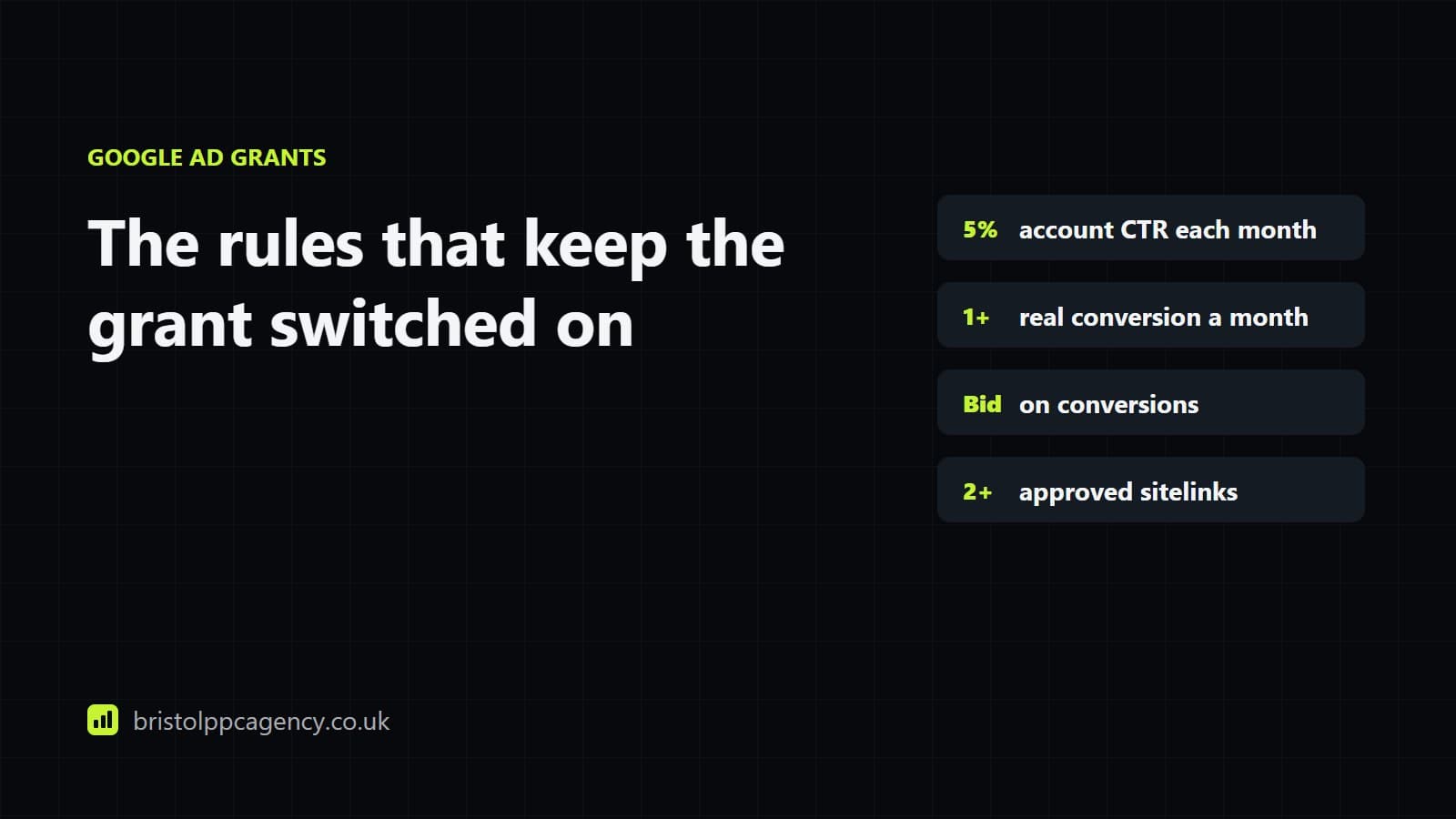
Google Ad Grants gives an eligible charity up to 10,000 US dollars of Search text ads every month, and Google switches the account off when its rules slip. The account must keep a 5% click-through rate across the whole account each month, record at least one real conversion a month, bid with a conversion-based Smart Bidding strategy, show ads only where the charity's services are useful, carry at least two sitelinks, and avoid single-word, generic and low Quality Score keywords. Miss the click-through rate two months running and Google temporarily deactivates the account.
Who can apply from Bristol
Ad Grants sits inside Google for Nonprofits, so the charity applies there first and activates the grant afterwards. Google's eligibility guidelines for the United Kingdom accept organisations registered with the Charity Commission, which covers a charity based in Bristol, along with the Northern Ireland and Scottish charity registers, charities recognised by HMRC for tax purposes, exempt charities and churches. Every applicant is then checked by Goodstack, Google's validation partner.
The same guidelines exclude government bodies, hospitals and healthcare organisations, and schools and universities. The exclusion has a gap worth knowing: the charitable arm or foundation of a healthcare organisation, and the philanthropic arm of a university, can apply. A hospital charity or a university's fundraising arm in the city may qualify where the parent body cannot.
Get the website right before you apply
Google reviews the site the ads will point to, and its Ad Grants website policy is specific. The charity must own the domain, and every page must load over HTTPS. The site has to state the mission and describe the work, links have to work, pages should load quickly on any connection, and donation links must go to a secure page dedicated to donations. AdSense ads are not allowed, and any selling has to stay secondary to the mission. Broken links and pages that fail to load can lead to rejection, so a site that has drifted for a few years needs a tidy-up before the application, not after it.
The rules in one table
These come from Google's Ad Grants account management policy and its mission-based campaigns policy, as published when this guide was written. Google changes them, so read the live pages before acting on any one row.
| Rule | What Google's policy says | What breaks it |
|---|---|---|
| Click-through rate | 5% across the account each month, not per keyword; two missed months in a row means temporary deactivation | A few broad keywords with thousands of impressions and few clicks |
| Conversions | Valid conversion tracking and at least one conversion a month | A thank-you page tag lost in a site rebuild, or a donation form that never reports back |
| Bidding | Every campaign on Maximise conversions, Maximise conversion value, target CPA or target ROAS (accounts created since 22 April 2019, Smart campaigns aside) | A campaign switched to Maximise clicks and left there |
| Location | Ads shown where people will find the charity's information and services useful | A Bristol-only service targeted at the whole country |
| Sitelinks | At least two unique sitelinks | Sitelinks removed or disapproved and never replaced |
| Keywords | No single-word keywords outside the exceptions, no overly generic keywords, nothing with a Quality Score of 1 or 2 | Keywords added in a hurry before an appeal or an event |
| Programme survey | A response from the charity, with Google's emails switched on | The survey lands in an inbox nobody reads |
Keeping the click-through rate above 5%
The 5% is an account figure for the month, so individual keywords can sit below it as long as the total does not. What pulls the total down is a small number of keywords that collect a great many impressions and few clicks. Google's compliance guide says to pause high-impression, low click-through keywords until the account is back at 5% or more over the last seven active days, and its reinstatement advice starts with the same step. Searches for the charity's own name help, because people looking for you by name tend to click.
Ads earn clicks when each one answers a single question. An ad for a food bank's opening times should give the days and the area and land on the page that lists them. An ad that tries to speak to donors, volunteers and people who need help, all at once, rarely suits any of them.
Keywords Google will pause
Google's mission-based campaigns policy bans single-word keywords. The exceptions are the charity's own brand terms, recognised medical conditions, acronyms, and a short published list that includes charity, donate and donation. Overly generic keywords are banned too, as are the names of other organisations, places, historical events or people on their own. "Bristol" on its own is a place; "dementia support groups in Bristol" is a search with a need behind it, and Google's own example of an acceptable keyword follows the same pattern, a type of place followed by your city.
Keywords with a Quality Score of 1 or 2 must be paused or removed, and Google suggests an automated rule that pauses them for you. Keywords that break the policy can be paused by Google without notice; the change shows in the account's change history, which is the first place to look when spend drops for no visible reason.
Conversions that count, and the bidding they drive
Google's Ad Grants conversion tracking guide describes the conversions it expects: donations and ticket sales, sign-ups, form submissions and downloads of key documents, each confirmed by a thank-you page, or by the click on the action button where there is no such page. Time on site and homepage visits can be tracked, but the policy says they must be kept out of the Conversions column. If the conversion rate looks high, Google asks you to confirm it comes from a meaningful action. For most Bristol charities the useful set is short: a donation, a volunteer enquiry, a referral or request for help, and perhaps a guide download.
Those conversions also steer the bids. The account management policy requires conversion-based Smart Bidding on every campaign in accounts created since 22 April 2019, unless the account uses Smart campaigns, and Google can change a non-compliant campaign's bid strategy automatically. Our guide to bidding strategies explains how Maximise conversions and target CPA behave once there is data to work with.
Location targeting for a Bristol charity
The policy asks for location settings that show ads where people will find your information and services useful. Google's examples draw the line clearly: a nationally known organisation can target widely, a local service such as a food bank should show ads only in its town or local area, and a charity with both local and national work should split them into separate campaigns. For most Bristol charities that means one campaign aimed at the city, or the city with South Gloucestershire and North Somerset where the service crosses those boundaries, and a separate campaign for any national helpline or appeal.
The survey, the emails and reinstatement
Google sends grantees a programme survey, which its compliance guide describes as annual, and expects a considered response. The notification address on the account must belong to someone who reads it, with Google's emails switched on, because most warnings arrive there or as notifications inside the account.
If the account is deactivated, fix the cause and then request reinstatement through Google's form. After a deactivation over bidding, the policy page suggests starting on Maximise clicks to bring in traffic while conversion tracking is set up, then moving to a conversion-based strategy once there is enough data, which it puts at typically 15 to 30 conversions in the last 30 days.
A monthly check that keeps the grant
- Account click-through rate for the month so far, and the keywords with the most impressions and the lowest click-through rate.
- Conversions recorded this month, checked against the donations and forms that reached the charity.
- Every campaign on a conversion-based bid strategy.
- Any keyword with a Quality Score of 1 or 2, and any single word added since last month.
- Location settings on any campaign created since the last check.
- At least two sitelinks, all approved.
- Account notifications, and the inbox the programme survey goes to.
We run this check, and the campaigns around it, as part of our charities and Ad Grants work. If your grant is live but spends a fraction of each month, or has already been paused, ask for a free audit and we will tell you which rule is holding it back.
Sources
- Google for Nonprofits: Google Ad Grants
- Google for Nonprofits Help: Ad Grants account management policy
Written by
Web developer and paid search specialist at Webso Digital, which runs Bristol PPC Agency. Builds the campaigns, the landing pages and the tracking, and writes these guides from that work.
Questions on this topic
How much is Google Ad Grants worth?
Up to 10,000 US dollars a month of in-kind advertising for text ads on Google Search. It is advertising credit inside a Google Ads account, not cash paid to the charity.
Does Ad Grants still have the 5% CTR rule?
Yes. Google's account management policy, read in November 2026, still requires a 5% click-through rate across the account each month, and two missed months in a row lead to temporary deactivation.
Can a small charity that is not on the Charity Commission register apply?
Possibly. Google's UK eligibility list also includes charities recognised by HMRC for tax purposes, exempt charities and churches, and every applicant is verified by Goodstack. An organisation that is not a charity by any of those routes is not eligible.
What counts as a conversion for Ad Grants?
A meaningful action such as a donation, a sign-up, a form submission or a download of a key document, ideally confirmed by a thank-you page. Time on site and homepage visits can be tracked but must not be counted as conversions.
Why would Google suspend our Ad Grants account?
Google's policy names the triggers: a click-through rate under 5% for two consecutive months, no conversions recorded, campaigns off conversion-based Smart Bidding, or no response to the programme survey. Fix the cause, then request reinstatement.
Can our Ad Grants ads target the whole of the UK?
Only if your services are useful across the UK. Google's policy asks for location settings matched to where people will find your services useful, so a service that runs only in Bristol should target Bristol and the area around it.