What is PPC? Pay-per-click advertising explained in plain English
What PPC is, how pay-per-click advertising works on Google and other platforms, what decides the price of a click, and when it makes sense for a business.
By Daniel Stoychev, Webso Digital · 3 October 2026 · 6 min read
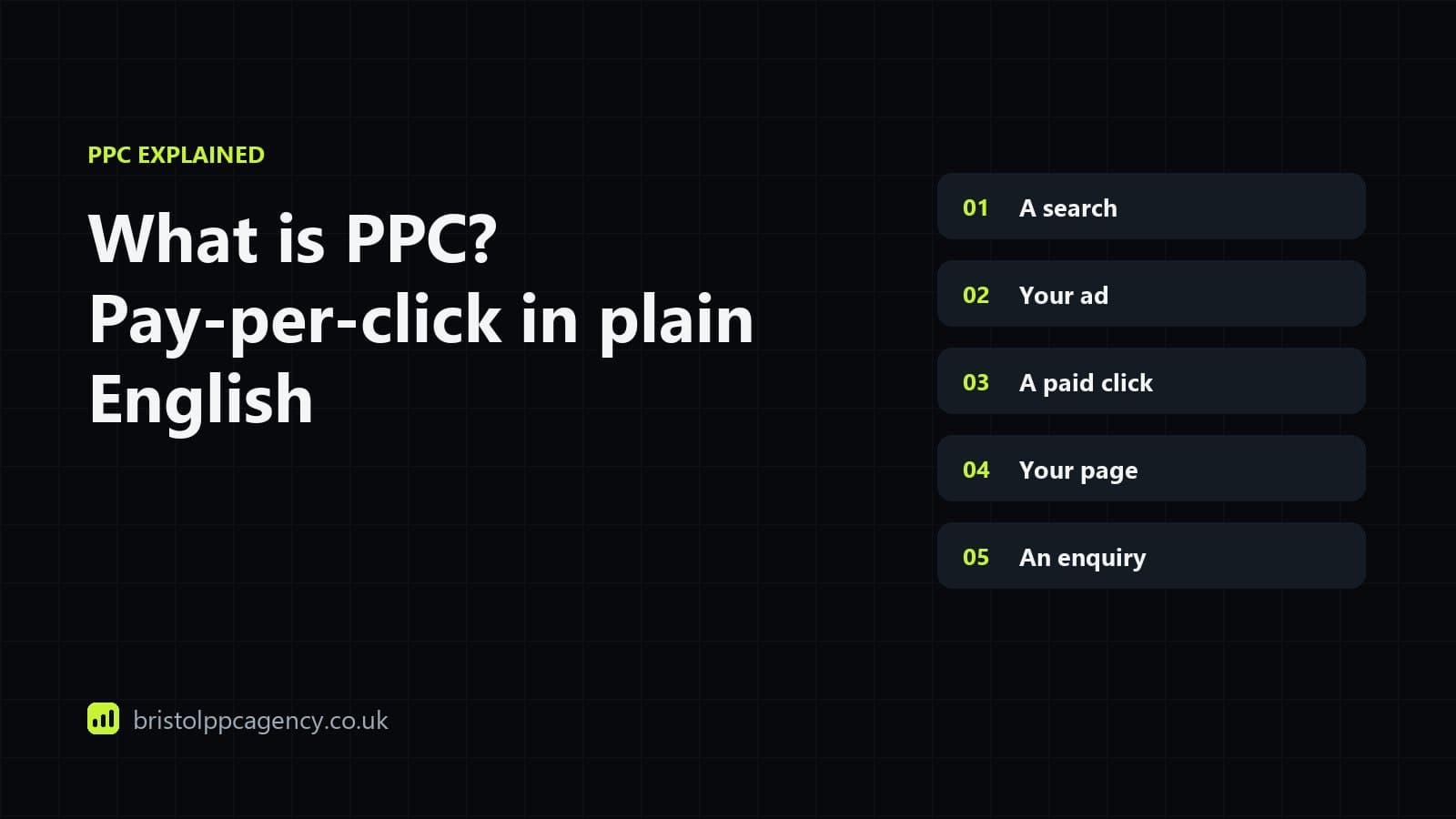
PPC, or pay-per-click, is a way of advertising online where you pay only when someone clicks your ad. The best-known form is Google Ads: you choose the searches you want to appear for, Google shows your ad to people making those searches, and you are charged each time someone clicks through to your website. The same model runs on Microsoft's Bing, on Facebook and Instagram, on LinkedIn and on YouTube.
How a pay-per-click ad gets shown
When someone searches on Google, an auction runs in a fraction of a second among every advertiser who wants to appear for that search. Google does not simply show the highest bidder. It combines your bid with an estimate of how relevant and useful your ad and landing page will be, and the result decides whether your ad shows and in what position.
Google measures that relevance with Quality Score, a diagnostic from 1 to 10 for each keyword, based on expected click-through rate, ad relevance and landing page experience. A better score can win a higher position for less money, which is why a well-built account often pays less per click than a careless one bidding more.
What you actually pay for a click
You set the most you are willing to pay, or let Google's automated bidding set it within a target. The price you pay is usually less than your maximum, because it depends on what the advertiser below you was prepared to pay and on both your Quality Scores. Prices vary enormously by industry: a click on a search for an emergency service or a professional service can cost many times more than a click on a search for a low-priced product.
For a sense of scale, Google's Keyword Planner showed top-of-page bids between about €18 and €96 for "ppc agency bristol" in our own research for this site, while many consumer product searches cost well under a pound. The only reliable way to know your costs is to look up your own searches; our guide to how much Google Ads costs explains how.
The main types of PPC
| Type | Where it shows | Best for |
|---|---|---|
| Search ads | Above and below Google and Bing results | People already searching for what you sell |
| Shopping ads | Product listings with image and price | Online shops |
| Display ads | Banners on websites and apps | Reaching people before they search; remarketing |
| Video ads | YouTube and other video placements | Explaining a product; building demand |
| Social ads | Facebook, Instagram, LinkedIn feeds | Targeting by interests, life events or job role |
| Local Services Ads | Top of Google for eligible services | Trades and local services, paid per lead |
Why businesses use it
- Speed: ads can appear the day a campaign launches, unlike organic search, which takes months.
- Intent: on search, you reach people at the moment they are looking for what you offer.
- Control: you choose the searches, the areas, the times of day and the budget, and can change them at any time.
- Measurement: with tracking in place, you can see which clicks became enquiries or sales and what each one cost.
Where it goes wrong
Pay-per-click is easy to start and easy to waste money on. The common problems are ads showing for searches the business never meant to pay for, conversion tracking that counts the wrong things, landing pages that do not match the ad, and default settings that spread the budget wider than the business serves. None of them is visible on the account's summary screen, which is why an account can look busy and lose money at the same time.
Is PPC right for your business?
PPC tends to work when three things are true: people search for what you sell, a customer is worth several times what it costs to win one, and your website can turn a visit into an enquiry or a sale. If you are not sure about the second, our PPC calculator works out what a budget could produce at a given cost per click and conversion rate. If you would rather have someone look at your actual market, the free PPC audit does that.
How a PPC account is organised
Every platform uses a similar structure, and understanding it explains most of what an agency does day to day. An account holds campaigns. Each campaign has a budget, a location, a schedule and a bidding strategy. Inside each campaign, ad groups collect keywords or audiences that share one meaning, and the ads that answer them.
| Level | What is set here | Example |
|---|---|---|
| Account | Billing, conversion tracking, linked tools | One account for the business |
| Campaign | Budget, location, schedule, bidding | Emergency plumbing, Bristol, 7am to 10pm |
| Ad group | Keywords or audience with one meaning | Burst pipe and leak searches |
| Ad | The text, images and landing page | Burst pipe? Engineer within the hour |
Getting the structure right matters because budgets and targets are set per campaign. If cheap, high-converting searches share a campaign with expensive ones, the account can look healthy while most of the spend is going to the expensive half.
Sources
- Google Ads Help: About Quality Score for search campaigns
- Google Ads Keyword Planner, United Kingdom, September 2025 to August 2026 (our export, 3 October 2026)
Written by
Web developer and paid search specialist at Webso Digital, which runs Bristol PPC Agency. Builds the campaigns, the landing pages and the tracking, and writes these guides from that work.
Questions on this topic
What does PPC stand for?
Pay-per-click. It describes advertising where the advertiser pays each time someone clicks the ad, rather than paying for the ad to be shown.
Is PPC the same as Google Ads?
Google Ads is the largest PPC platform, but not the only one. Microsoft Advertising, Meta, LinkedIn and others also sell ads on a pay-per-click basis.
How quickly does PPC work?
Ads can show the day they launch. Useful results take longer: usually a few weeks of clicks before you can judge which searches and ads produce customers.
Do I pay if nobody clicks?
For standard search ads, no: you pay for clicks, not impressions. Some campaign types and bidding options charge differently, so check how each campaign is set to bid.
What is the difference between PPC and SEO?
PPC buys a place in the results for as long as you pay; SEO earns an unpaid place over time by making your site the best answer. Many businesses use both.