What is ROAS? How to calculate it and what a good ROAS is
ROAS is revenue from ads divided by what the ads cost. How to calculate it, why a good ROAS depends on your margin, and how to work out break-even.
By Daniel Stoychev, Webso Digital · 3 October 2026 · 6 min read
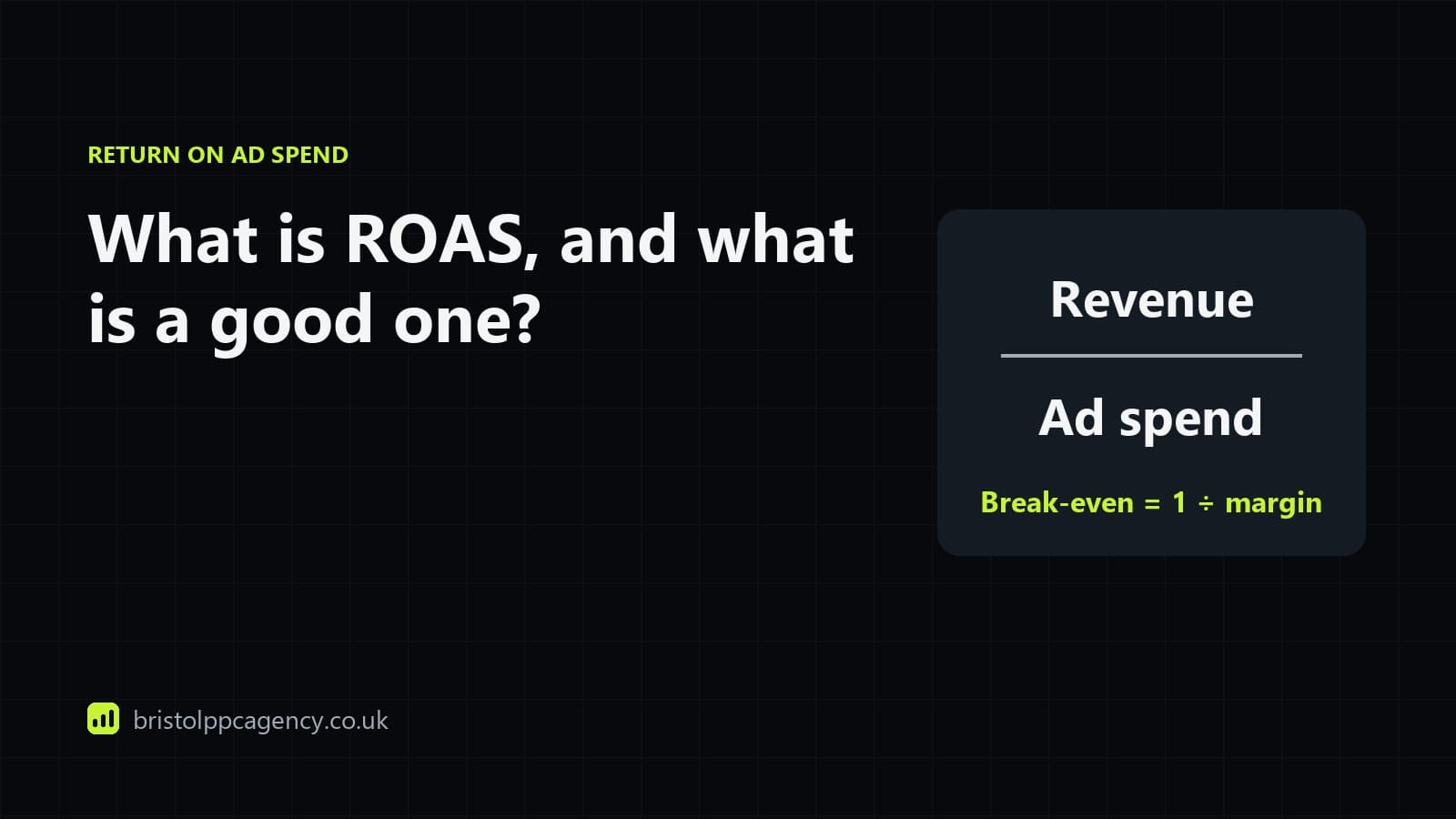
ROAS stands for return on ad spend. It is the revenue your ads produced divided by what those ads cost: spend £1,000 and make £4,000 in sales and your ROAS is 4, often written 4x or 400%. A good ROAS is not a fixed number. It is one that leaves a profit after the cost of the goods you sold, so the ROAS a business needs depends on its margin.
How to calculate ROAS
The formula is ROAS = revenue from ads ÷ ad spend. Use the same period and the same campaigns for both figures. If a campaign cost £2,500 last month and the sales it produced were worth £11,250, the ROAS is 11,250 ÷ 2,500 = 4.5x.
The revenue figure normally comes from conversion tracking: Google Ads, Microsoft Advertising and Meta record the value of each purchase they can attribute to an ad. Those figures are only as good as the tracking behind them, so if the platform reports more sales than your shop received, fix the tracking before trusting the ROAS. Our tracking service covers how.
Break-even ROAS: the number that matters most
Revenue is not profit. Before an ad pays for itself, the sale has to cover the cost of the product, and only the gross margin is left to pay for advertising. That gives a simple rule: break-even ROAS = 1 ÷ gross margin.
| Gross margin | Break-even ROAS | What it means |
|---|---|---|
| 20% | 5.0x | Every £1 of ads must bring £5 of sales just to break even |
| 30% | 3.33x | A 3x ROAS loses money |
| 40% | 2.5x | A 3x ROAS makes a modest profit |
| 60% | 1.67x | A 2x ROAS is already profitable |
| 80% | 1.25x | Typical of digital products and some services |
This is why two shops can both report a 3x ROAS and one is losing money while the other is growing. Our ROAS calculator works out break-even and target ROAS for any margin.
Target ROAS: break-even plus the profit you want
Most businesses want more than to break even. If you want to keep 10% of revenue as profit after advertising, your target ROAS is 1 ÷ (margin − 10%). At a 40% margin that is 1 ÷ 0.30, or 3.33x. This is the figure to give Google Ads if you use its target ROAS bidding, and it should be set per product group if your margins vary.
Why the reported ROAS can mislead
- Brand searches and remarketing usually show a very high ROAS, because many of those customers were going to buy anyway. Mixing them with prospecting campaigns makes the whole account look better than it is.
- Attribution windows decide how long after a click a sale still counts. Longer windows credit ads with more sales.
- Refunds and cancellations are rarely subtracted unless you upload them.
- Repeat customers bring revenue that a single-purchase ROAS ignores. A campaign can look weak on first orders and be excellent over a year.
ROAS for lead generation businesses
If you sell services rather than products, the platform does not know the revenue at the moment someone enquires. You can still use ROAS by giving each conversion a value, such as the average value of a won customer multiplied by the share of leads that become customers, or by importing the real value from your CRM once a deal closes. Many service businesses find cost per lead or cost per acquisition easier to work with.
How to improve ROAS
- Fix tracking first, so the number is true.
- Separate brand, prospecting and remarketing so each is judged on its own.
- Set targets by margin band rather than one shop-wide figure.
- Remove spend from search terms and products that never convert.
- Improve the landing page: a better conversion rate lifts ROAS without changing the ads.
ROAS, CPA and ROI compared
| Measure | Formula | Best for |
|---|---|---|
| ROAS | Revenue from ads ÷ ad spend | Shops and anything with a sale value |
| CPA | Ad spend ÷ conversions | Lead generation where each lead is worth about the same |
| ROI | (Profit − all costs) ÷ all costs | Judging the whole investment, not just the ads |
They answer different questions, so use the one that matches your business. A shop running target ROAS should still check profit after the cost of goods; a lead generation business running target CPA should still check how many leads became customers.
Where to find ROAS in Google Ads
Google Ads reports ROAS as Conversion value ÷ cost, a column you can add to any campaign, ad group or product report. It relies on each conversion carrying a value, which an online shop's tracking normally sends automatically and a service business has to set up. If the column shows nothing, the conversions have no values yet.
Written by
Web developer and paid search specialist at Webso Digital, which runs Bristol PPC Agency. Builds the campaigns, the landing pages and the tracking, and writes these guides from that work.
Questions on this topic
What is a good ROAS?
One above your break-even point, which is 1 divided by your gross margin, with room for the profit you want. There is no universal good figure because margins differ so much between businesses.
Is ROAS the same as ROI?
No. ROAS compares revenue with ad spend only. ROI compares profit with all the costs involved, including the cost of goods, staff and fees. A campaign can have a healthy ROAS and a negative ROI.
How do I calculate ROAS as a percentage?
Multiply the ratio by 100. A ROAS of 4.5x is 450%, meaning £4.50 of revenue for every £1 of ad spend.
What ROAS should I set in Google Ads?
Your target ROAS: 1 divided by your gross margin minus the profit percentage you want to keep. Set it per product group if margins vary, and expect a learning period after changing it.
Why is my ROAS high but I am not making money?
Usually because the margin is lower than the break-even ROAS requires, because remarketing and brand campaigns are inflating the figure, or because refunds and other costs are not included.