Is Google Ads worth it? A decision framework for your business
Is Google Ads worth it? The four questions that decide it: search demand, customer value, conversion rate and margin, and the warning signs.
By Daniel Stoychev, Webso Digital · 3 October 2026 · 5 min read
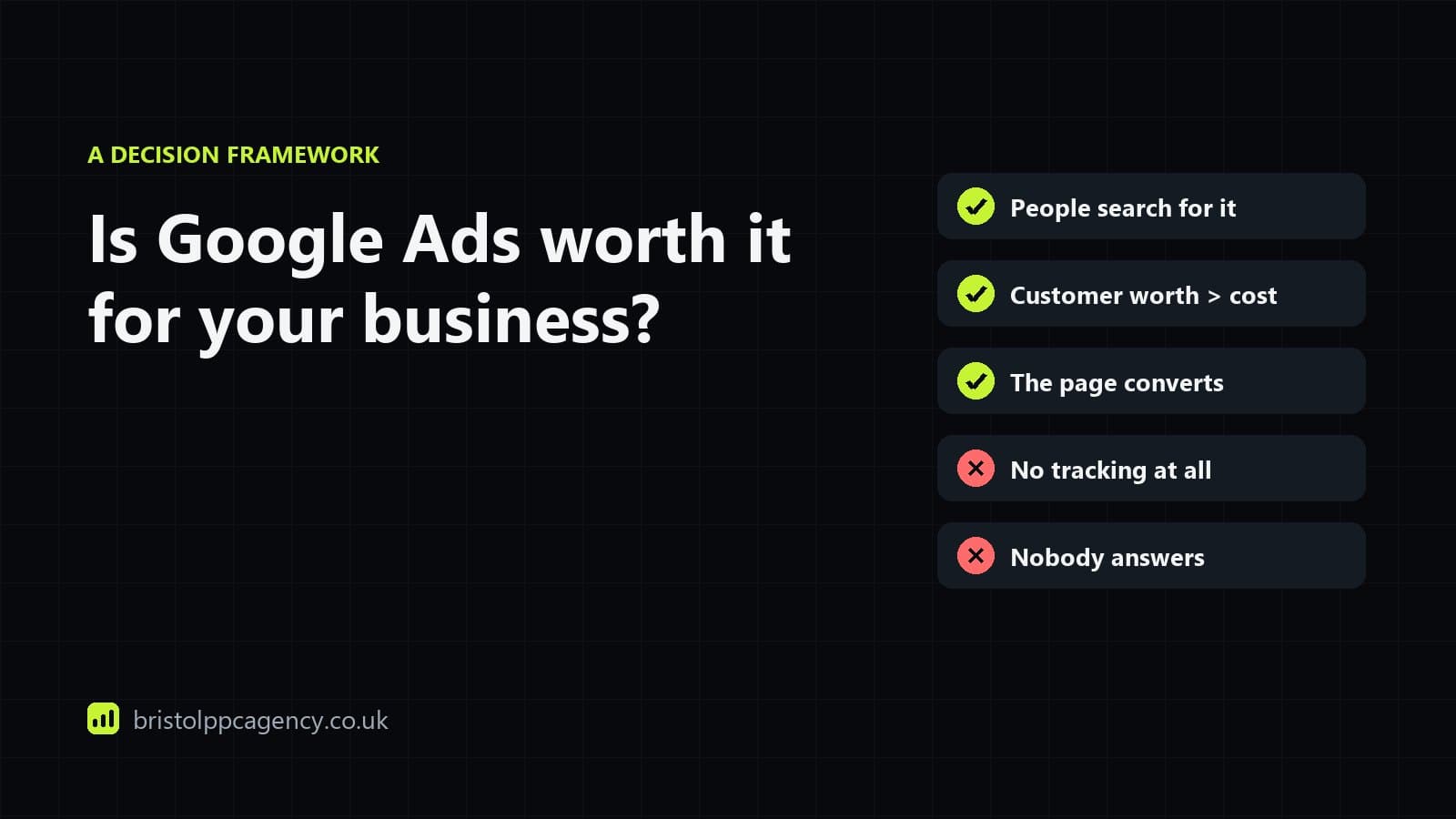
Google Ads is worth it when people search for what you sell, a new customer is worth comfortably more than the ad spend it takes to win one, and your website can turn visitors into enquiries or sales. If all three hold, it is one of the most controllable ways to grow. If one of them fails, more budget will not fix it, and the money is better spent on that weakness first.
Four questions that decide it
- 01Do people search for it?Look up your main services or products in Keyword Planner for your area. If almost nobody searches, search ads have little to work with, and channels that create demand, such as social or video, may suit you better.
- 02What is a customer worth?Not the first order but the realistic value of a customer over time, after the cost of delivering the work or the product.
- 03What will a customer cost?Cost per click divided by the chance a click becomes a customer. At £2 a click and 1 customer per 50 clicks, that is £100.
- 04Can the site convert?If a visitor cannot quickly see what you do, why you, and how to get in touch, paid clicks leak away. Fix the page before paying for traffic.
If the value of a customer is well above what one costs to win, Google Ads is likely to be worth it. Our PPC calculator does the arithmetic with your own numbers.
When it usually is worth it
- Urgent needs: people searching for an emergency service call within minutes.
- High-value services: one customer pays for many clicks.
- Products with clear search demand and healthy margins.
- New businesses that need enquiries before organic search has had time to build.
- Businesses testing a new service or area, because paid search shows quickly whether there is demand.
When it usually is not, yet
- Very low margins, where the break-even cost per sale is lower than the cost of the clicks needed to make one.
- A product nobody knows to search for. Demand has to be created first.
- A website that is slow, unclear or impossible to use on a phone.
- Nobody to answer the phone or reply to enquiries quickly.
- No way of tracking which clicks became customers, so nobody can tell whether it worked.
How long to give it
Long enough to buy a few hundred clicks on your main searches, which is usually one to three months depending on budget and cost per click. In that time the account should move from guesswork to a cost per lead or cost per sale you can compare with what a customer is worth. Judging it after a week, or on clicks rather than customers, gives the wrong answer either way.
Doing it well matters as much as doing it
Many businesses that decide Google Ads does not work have tried it with default settings: broad matching with no negative keywords, location set wider than they serve, conversions counted wrongly and traffic sent to the homepage. The same budget in a well-structured account can produce a very different result. A free audit of an existing account usually shows quickly whether the problem is the channel or the setup.
A worked example
This example is illustrative. A Bristol plumbing business finds that searches for its main services cost about £3 a click. Its website turns roughly 1 in 12 visitors into an enquiry, and it wins about half of the enquiries it quotes. Each job is worth £280 after materials.
- Cost per enquiry: £3 × 12 = £36.
- Cost per job won: £36 × 2 = £72.
- Value of a job: £280.
- Each job costs about a quarter of what it earns, before staff time. Google Ads is likely to be worth it.
Now change one number. If the website converted 1 in 40 visitors instead of 1 in 12, each job would cost £240 to win and the margin would almost disappear. The channel has not changed; the page has. That is why we look at the landing page in every audit.
What to test in the first month
- One campaign for the most profitable service, in the area you serve best.
- Phrase and exact match keywords, with a starter negative keyword list.
- A landing page that matches the ad, with calls and forms tracked.
- A weekly look at the search terms report, adding negatives as you go.
Written by
Web developer and paid search specialist at Webso Digital, which runs Bristol PPC Agency. Builds the campaigns, the landing pages and the tracking, and writes these guides from that work.
Questions on this topic
Is Google Ads worth it for a small business?
Often, when people search for what you sell and a customer is worth several times what it costs to win one. Keep the first campaign narrow, on your most profitable service, and track every enquiry.
How do I know if my Google Ads are working?
Compare cost per lead or cost per sale with what a customer is worth, using conversion tracking you trust. Clicks and impressions alone do not tell you.
Is Google Ads better than SEO?
They do different jobs. Google Ads is fast and controllable but stops when you stop paying; SEO is slower but keeps working. Many businesses use ads while SEO builds.
Why do some businesses say Google Ads does not work?
Usually because of setup rather than the channel: default settings, poor tracking, irrelevant search terms or weak landing pages. A well-run account with the same budget can perform very differently.
What if my competitors already advertise heavily?
It raises the cost per click but does not settle the question on its own. A better landing page, tighter targeting and a clear offer can win customers at a lower cost than a competitor spending more. Check your own cost per customer before assuming you are priced out.