Google Ads bidding strategies: target CPA, target ROAS and when to use each
Google Ads bidding strategies: Maximise conversions, target CPA, target ROAS and manual bidding, when each works, and where Performance Max fits.
By Daniel Stoychev, Webso Digital · 3 October 2026 · 6 min read
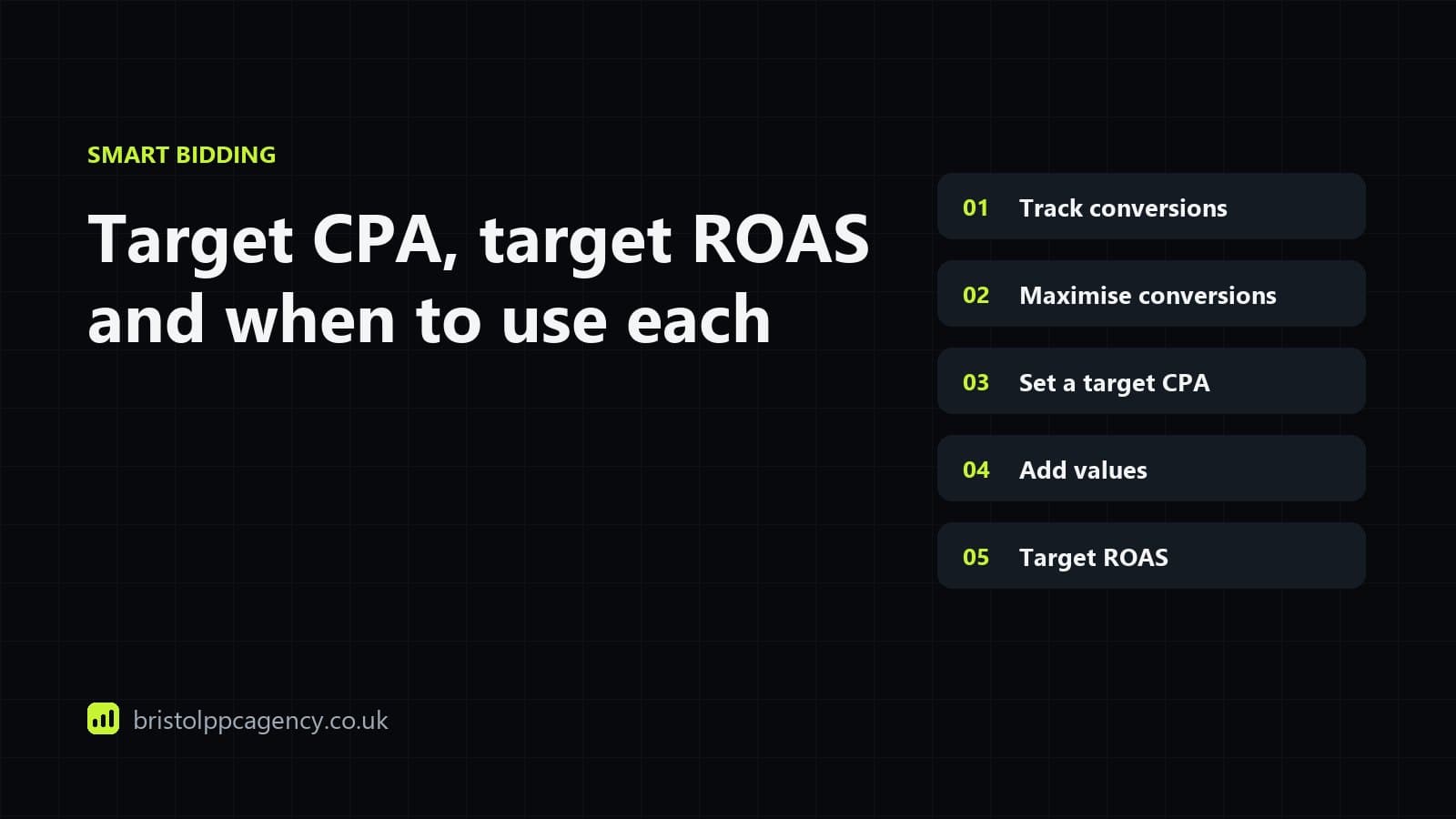
Google Ads bidding strategies decide how much you bid in each auction. Smart Bidding strategies such as Maximise conversions, target CPA and target ROAS let Google set bids automatically from signals like device, location and time, aiming at the goal you choose. They work well when the account has enough reliable conversion data to learn from; with very little data, simpler strategies and tighter control usually do better.
The main strategies
| Strategy | What it does | Use it when |
|---|---|---|
| Maximise clicks | Gets as many clicks as possible within budget | Very early, to gather data; rarely for long |
| Manual CPC | You set bids yourself | Small accounts, or where you need tight control |
| Maximise conversions | Gets as many conversions as possible within budget | Conversions are tracked but you have no target yet |
| Target CPA | Aims for conversions at your chosen cost per acquisition | Steady conversion volume and a known affordable cost per lead |
| Maximise conversion value | Gets as much conversion value as possible within budget | Conversions carry values, no target yet |
| Target ROAS | Aims for your chosen return on ad spend | Values are tracked reliably and you know your margin |
Target CPA or target ROAS?
Use target CPA when every conversion is worth roughly the same to you, such as leads for one service. Use target ROAS when conversions differ in value, such as online orders of different sizes, and the values are tracked accurately. Target ROAS is only as good as the values behind it; if refunds, cancellations or lead quality are not reflected, it optimises toward the wrong customers.
For target ROAS, set the target from your margin: 1 divided by gross margin is break-even, and adding the profit you want gives the target. Our guide to ROAS explains the sum.
Maximise conversions or target CPA?
Maximise conversions spends the whole budget chasing as many conversions as it can, which can push the cost per conversion up when budget is generous. Target CPA aims for a cost you set and may spend less than the budget if it cannot find conversions at that price. A common path is to start with Maximise conversions, see what cost per conversion it achieves, then set a target CPA close to that and tighten it gradually.
How much data Smart Bidding needs
Smart Bidding learns from conversions. An account with only a handful a month gives it little to learn from, and its decisions will be noisy. Grouping campaigns with similar goals under a portfolio strategy, or using a higher-volume conversion action earlier in the journey, can give it more data. Wherever possible, the conversion it learns from should still be a real business outcome.
Learning periods and changes
After a new strategy or a large change in target or budget, Smart Bidding goes through a learning period and results can swing. Change one thing at a time, avoid large target changes in one step, and allow time before judging. Seasonality adjustments tell Google about short, expected changes in conversion rate, such as a sale weekend, so it does not overreact.
Performance Max and standard Shopping
Performance Max always uses Smart Bidding toward conversions or conversion value, across all of Google's channels from one campaign. Standard Shopping campaigns give more control over bids and search terms for product ads. Many shops run both: Performance Max for reach and automation, standard Shopping for products where precise control matters. See Shopping and Performance Max.
The rule that matters most
Every automated strategy optimises to the conversions you give it. If tracking counts the wrong things, the cleverest strategy will find more of the wrong things. Fix tracking before choosing a bidding strategy.
Bidding by account size
A rough guide to where most accounts start. The right choice depends on conversion volume and how reliable the tracking is, not on budget alone.
| Account stage | Typical starting strategy |
|---|---|
| New, conversions not yet tracked | Fix tracking first; manual CPC or Maximise clicks with a bid limit for a short time only |
| A few conversions a month | Maximise conversions, or manual CPC with close control |
| Steady conversions every week | Target CPA set near the achieved cost per conversion |
| Conversion values tracked reliably | Maximise conversion value, then target ROAS from your margin |
Portfolio strategies and shared budgets
A portfolio bid strategy applies one Smart Bidding strategy and target across several campaigns, which pools their conversion data. It helps when individual campaigns are too small to learn on their own. Shared budgets let campaigns draw on one pot of money. Both make sense only for campaigns with similar goals, so the pooled data means the same thing.
Sources
Written by
Web developer and paid search specialist at Webso Digital, which runs Bristol PPC Agency. Builds the campaigns, the landing pages and the tracking, and writes these guides from that work.
Questions on this topic
What is Smart Bidding?
Google's group of automated bidding strategies, including Maximise conversions, target CPA, Maximise conversion value and target ROAS, which set bids in each auction using signals such as device, location and time.
When should I switch from manual bidding to Smart Bidding?
When the account has reliable conversion tracking and a steady flow of conversions. With very few conversions, manual or simpler bidding usually performs more predictably.
Why did my costs go up after changing bid strategy?
Smart Bidding goes through a learning period after a change, and a target that is too loose or a generous budget under Maximise conversions can push costs up. Give it time and adjust targets gradually.
Is Performance Max better than Shopping?
Neither is better in every case. Performance Max reaches more of Google's channels with more automation; standard Shopping gives more control. Many shops use both.