Remarketing after Consent Mode: smaller lists and a tag after Accept
UK remarketing after Consent Mode v2: who can join a list, the 100-user minimum, basic versus advanced mode, and the page speed we won back on this site.
By Daniel Stoychev, Webso Digital · 3 November 2026 · Updated 12 November 2026 · 7 min read
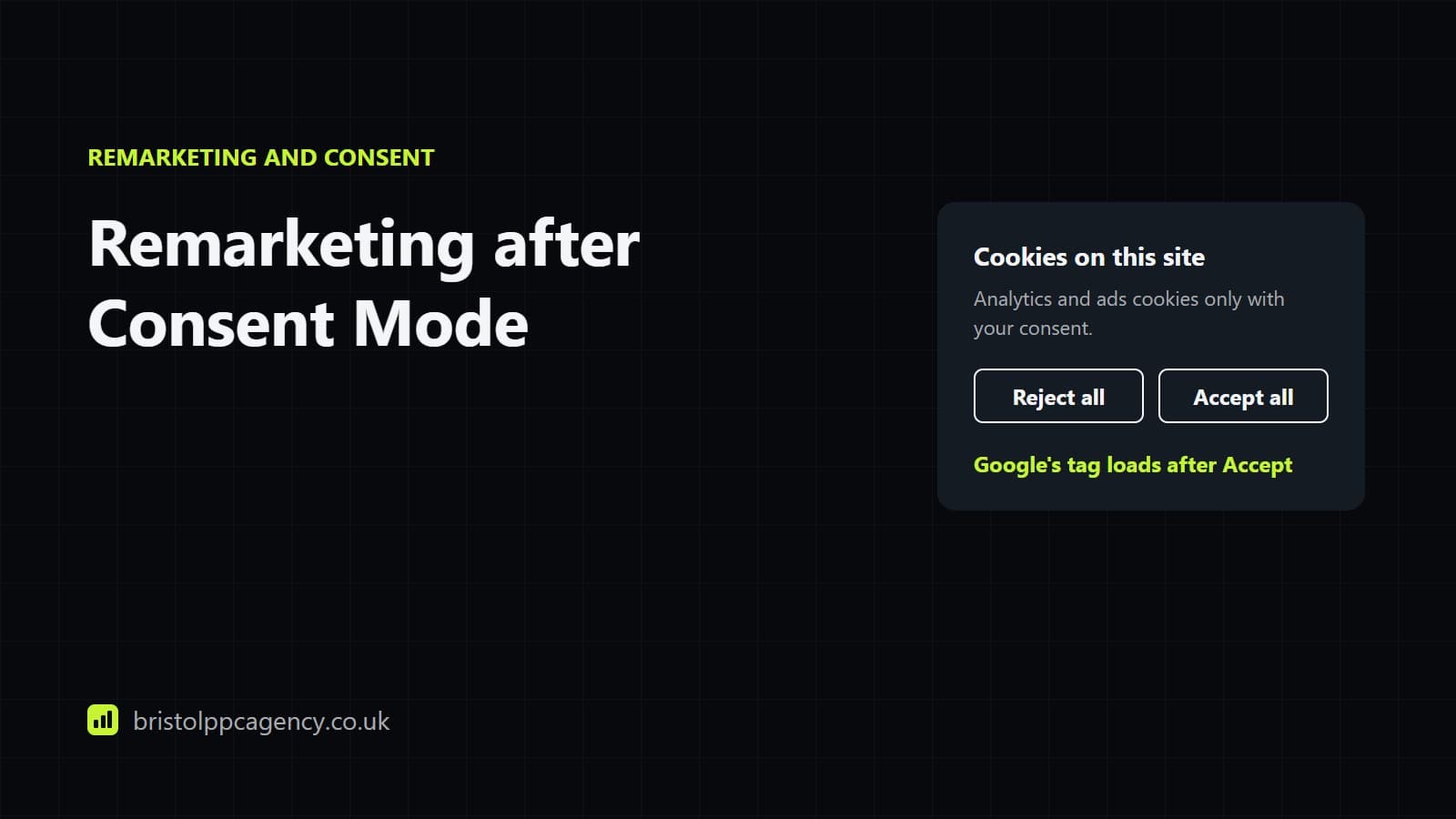
In the UK a visitor can join a Google remarketing list only after agreeing to advertising cookies, so every list now holds the people who clicked Accept and nobody else. Each list needs at least 100 active users in the last 30 days before it can serve on Search, Display or YouTube, which rules out narrow lists on smaller sites. On this site we load Google's tag only after Accept, because Consent Mode with everything denied still made every visitor download the 161 KB tag file, and stopping that took our home page to a median mobile score of 99.
Who ends up on a remarketing list now
Two rules decide it. The ICO's guidance on storage and access technologies says that using them for online advertising requires consent, and that none of the exceptions in PECR covers advertising. Google's EU user consent policy applies to end users in the UK as well as the EEA and Switzerland, and asks for consent to cookies where the law requires it and to the use of personal data for ad personalisation.
Consent Mode passes the visitor's choice to Google's tags as four signals: ad_storage for advertising cookies, ad_user_data for sending user data to Google for advertising, ad_personalization for personalised ads, and analytics_storage for analytics. Google's developer documentation is direct about the result for remarketing: when ad_personalization is denied, remarketing in Google Ads receives no data from that visitor.
Google's policy help page adds that it does not currently expect advertisers to send a verified consent signal for UK traffic, as it does for traffic from the EEA. That changes Google's paperwork, not UK law: the ICO's rule on advertising cookies applies either way. A banner that makes Reject as easy as Accept, as this site's does, produces a smaller list than one that buries the Reject button, and the smaller figure is the audience you have permission to reach.
The 100-user floor
Google's audience help pages set the minimum: a segment needs at least 100 active visitors or users within the last 30 days to serve on the Display Network, Search or YouTube. Customer lists uploaded or refreshed since 1 February 2024 have the same 100-user floor. A new website visitor segment starts empty and fills only from the day it is created, with membership lasting 30 days by default and up to 540.
Work it backwards before building anything. Take the monthly visitors to the pages a list would collect, multiply by the share who accept your banner, and see whether the answer clears 100 comfortably. On a small site the narrow, high-intent lists, such as quote page visitors in the last seven days, are the first to stay under the floor. Broad lists, such as all visitors over 90 days, are the ones that serve.
Get the accept rate from your consent tool's log or from an event fired on the Accept button. GA4 cannot tell you, because on a site set up like this one GA4 only ever sees the visitors who accepted.
Basic or advanced Consent Mode
Google describes two set-ups. In basic mode the Google tag does not load until the visitor makes a choice, and nothing is sent to Google if they reject. In advanced mode the tag loads on every page view with consent denied by default, and sends cookieless pings while consent is denied.
| Basic | Advanced | |
|---|---|---|
| When the Google tag loads | Only after the visitor accepts | On every page view, consent denied by default |
| Sent before or without consent | Nothing | Cookieless pings |
| Conversion modelling in Google Ads | A general model | An advertiser-specific model |
| Who can join a remarketing list | Visitors who accepted | Visitors who accepted |
| Download cost for every visitor | None until Accept | The full tag file |
The fourth row is the one that matters for remarketing. Advanced mode improves how Google models the conversions it cannot observe; it adds nobody who rejected to your lists. If list size is your reason for weighing the two modes, the lists come out the same either way.
What loading the tag after Accept did to this site
On 6 October 2026 we measured this site running Consent Mode with analytics denied by default. The Google tag file, gtag.js, weighs 161 KB, and every visitor downloaded it whether they accepted or not. Mobile Lighthouse scores ran from 72 to 88, with first paint at 3.0 seconds.
We changed one thing. The page still sets the denied defaults, but it fetches gtag.js only when a visitor clicks Accept, or on a later visit from someone who accepted before. The home page then scored a median of 99 and a service page 98, over three runs each. First paint fell to 1.0 second, and page weight from 462 to 301 KiB. We made the same change on a client's detailing site the same day, and its scores moved the same way.
To repeat the test on your own site, run Lighthouse on its mobile setting at least three times for each page, before and after the change, and compare the medians. Lighthouse scores vary from run to run on the same page, so one good or bad run proves little.
This site runs Google Analytics only, with no Ads tag, but Google Ads loads through the same Google tag, so an advertiser faces the same trade. What we gave up was the cookieless pings, and with them the advertiser-specific modelling. For a lead-generation site judged on enquiries in its own inbox, a faster first screen for every visitor was worth more to us than better modelling of the visitors who said no. A shop whose bidding leans on modelled conversions might weigh it the other way, and should test both.
Building lists that survive a smaller pool
- Start with one broad list, all visitors over 30 or 90 days, and split it only once it sits well above the floor.
- Make high-intent lists a little wider than ideal: all service pages rather than one quote page, 30 days rather than seven.
- Exclude people who have already enquired or bought, using a list built from the thank-you page or the form event.
- Add a Customer Match list from customers whose details you hold lawfully, following Google's Customer Match policy.
- Report each remarketing campaign apart from prospecting, so returning visitors who would have come back anyway do not flatter the figures.
Checking it works
Open the site in a clean browser profile with no extensions, reject, and watch the network panel: nothing should be fetched from googletagmanager.com. Clear the choice, accept, and the tag should load once. If it still loads before any choice is made, look for a second copy added by a plugin or a tag manager container, because the consent gate controls only the copy it loads itself. Then check the segment in Google Ads after a week or two. A list that never reaches the serving minimum is telling you about your traffic and your banner, not about a broken tag.
If your lists shrank when the banner went in and you want to know which are still worth paying for, our remarketing work starts with that question, and the free audit covers consent and tag loading as part of the tracking review.
Sources
Written by
Web developer and paid search specialist at Webso Digital, which runs Bristol PPC Agency. Builds the campaigns, the landing pages and the tracking, and writes these guides from that work.
Questions on this topic
Do UK visitors have to consent before I can remarket to them?
Yes. The ICO's guidance says storage and access technologies used for online advertising need consent, and no exception covers them. A visitor who rejects advertising cookies cannot be added to a Google remarketing list.
What is the minimum size for a Google remarketing list?
100 active visitors or users in the last 30 days for Display, Search and YouTube, according to Google's audience help pages. Customer lists uploaded or refreshed since 1 February 2024 follow the same 100-user rule.
Does advanced Consent Mode give me bigger remarketing lists?
No. Visitors who deny ad personalisation send no data to remarketing in either mode. Advanced mode improves conversion modelling through cookieless pings, at the cost of loading the tag for every visitor.
Is Consent Mode v2 required for UK traffic?
Google's policy help page says it does not currently expect a verified consent signal for UK traffic, as it does for the EEA. UK law still requires consent for advertising cookies, so a proper banner passing the choice to Google's tags remains the right set-up.
Why did my remarketing lists shrink after adding a cookie banner?
Because only visitors who accept advertising cookies can now be added. The smaller list is the audience you have permission to reach; build fewer, broader lists so they stay above the 100-user minimum.