A PPC strategy that works: how to plan a paid search account from scratch
How to build a PPC strategy: one success measure, campaigns structured by what a click is worth, tracking fixed first, and how budget moves each month.
By Daniel Stoychev, Webso Digital · 3 October 2026 · 6 min read
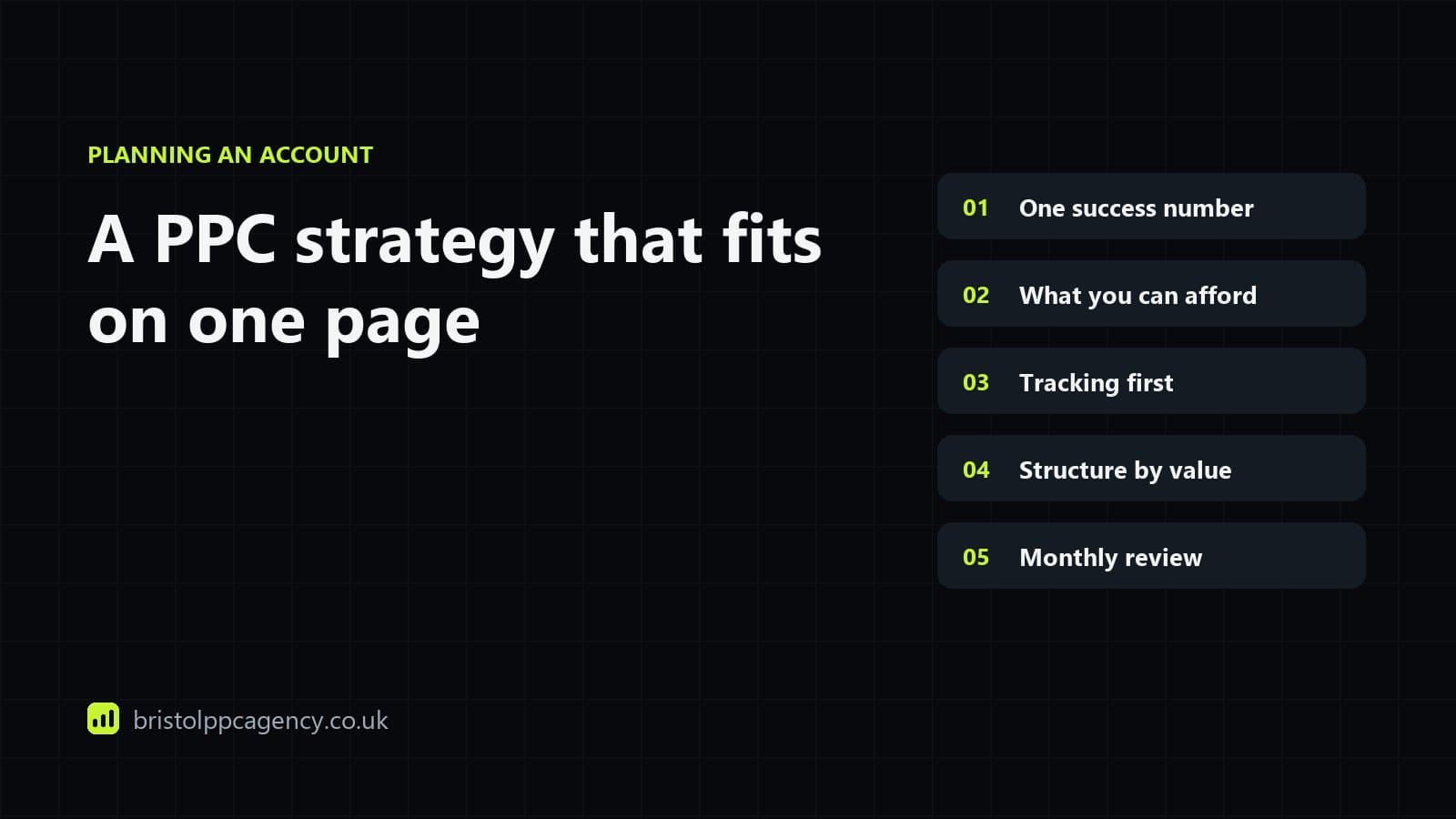
A PPC strategy is a written plan for what your paid advertising has to achieve, how you will measure it, which searches and audiences you will pay for, how the budget is split, and how decisions get made each month. The strategies that work are short and specific: one number that defines success, campaigns grouped by what a click is worth, tracking you trust, and a fixed routine for moving money to what is working.
1. Decide what success means, in one number
Pick the measure the business actually cares about and the range it must sit in. For a service business that is usually cost per qualified lead or cost per customer; for a shop, return on ad spend against margin. Everything else, clicks, click-through rate, impressions, is a diagnostic. Without one agreed number, every month's report can be read as success.
2. Work out what you can afford to pay
Start from the value of a customer after costs, then work back through the conversion rates: enquiries to customers, clicks to enquiries. That gives the most you can pay for a lead and for a click. If Keyword Planner shows your searches cost more than that, the strategy has to change, by targeting more specific searches, improving the landing page or raising the value of a customer, before any budget is spent.
3. Fix measurement before anything else
Automated bidding optimises to whatever you tell it is a conversion. If that includes page views, duplicate form fills or calls of five seconds, it will find more of them very efficiently. Define real conversions, give them values where you can, and check them against your own records. See tracking.
4. Structure campaigns by value, not by habit
| Campaign | Searches | Why separate |
|---|---|---|
| Brand | Your business name | Cheap, high-converting; would hide the true cost of everything else |
| Core services or products | What you sell, high intent | Where most budget and the main target sit |
| Research | Questions and comparisons | Lower intent; needs a lower target or different pages |
| Competitor and alternative | People comparing providers | Different cost and conversion rate |
| Remarketing | Past visitors | Easy to over-credit; judged on its own |
Each campaign gets its own budget and target, so the cheap conversions in one cannot disguise expensive ones in another.
5. Choose platforms in order
Most businesses start with Google search, because it captures existing demand. Microsoft Advertising is often the cheapest second step. Meta and YouTube come in when you need to create demand, show a visual product or retarget. Adding platforms before the first one works spreads the budget too thin to learn from.
6. Write down the review routine
- Weekly: search terms reviewed, negative keywords added, anything broken fixed.
- Fortnightly: ad and landing page tests checked, losing variants retired once there is enough data.
- Monthly: performance against the one number, budget moved between campaigns, the next test chosen.
- Quarterly: targets revisited against margins, new services or areas considered.
7. Plan for the learning period
Automated bidding needs time and conversions to learn after a launch or a big change, and performance is often uneven for the first weeks. Make one significant change at a time and give it time to settle, so you can tell what caused any change in results.
What a strategy is not
It is not a list of every campaign type available, a promise of a ROAS figure before the account has data, or a document written once and never read again. A good PPC strategy fits on a page and gets checked every month.
An example one-page strategy
This is an illustration of the format, for a fictional Bristol physiotherapy clinic. Your own would use your numbers.
| Section | Example |
|---|---|
| Goal | New patient bookings at £45 or less each |
| Affordable cost | A new patient is worth about £300 over a course of treatment |
| Measurement | Online bookings and calls over 60 seconds, checked weekly against the diary |
| Structure | Brand; sports injury; back and neck pain; remarketing |
| Platforms | Google search first; Meta remarketing once search is profitable |
| Budget split | Most on the two treatment campaigns, a small share on brand and remarketing |
| Review | Weekly search terms, monthly budget moves, quarterly target check |
Written like this, anyone in the business can see what success means and check whether the account is delivering it.
Written by
Web developer and paid search specialist at Webso Digital, which runs Bristol PPC Agency. Builds the campaigns, the landing pages and the tracking, and writes these guides from that work.
Questions on this topic
What should a PPC strategy include?
One success measure and its target range, what you can afford per lead or sale, how conversions are tracked, the campaign structure, the platforms in priority order, the budget split and the review routine.
How often should a PPC strategy change?
The routine runs weekly and monthly, but the strategy itself should change only when the evidence says so: after a quarter of data, a change in margins, or a new service or market.
Should I use automated bidding?
Once the account has enough reliable conversions for it to learn from, usually yes. With very few conversions, simpler bidding and tighter control often perform better until volume grows.
How many campaigns should I have?
As few as possible while keeping things of different value apart. Too many small campaigns each get too little data; one campaign doing everything hides what is working.
Who should own the PPC strategy?
The business, even if an agency writes it. The strategy should state your goals, your margins and what you can afford per customer, which only you can confirm. An agency's job is to turn that into campaigns and report against it.