Landing page best practices for PPC: what turns paid clicks into leads
Landing page best practices for PPC: match the ad, answer the first questions on screen one, load fast on mobile, keep forms short and track properly.
By Daniel Stoychev, Webso Digital · 3 October 2026 · 5 min read
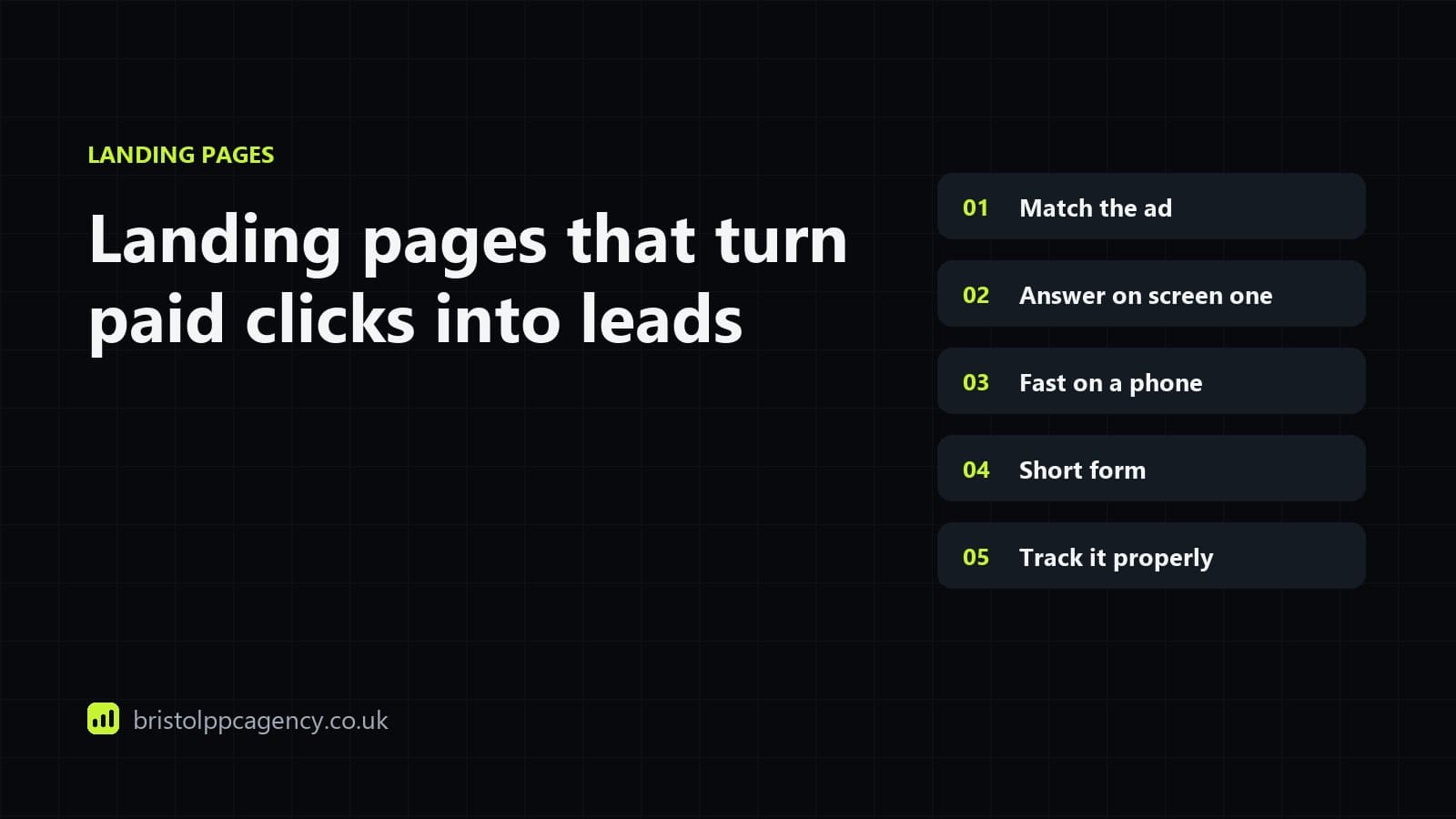
A good PPC landing page repeats the promise the ad made, answers the visitor's first questions on the first screen, loads quickly on a phone, and makes the next step obvious and easy. Every click has already been paid for when it arrives, so the landing page decides how much of that spend turns into enquiries. Improving it is often the cheapest way to lower your cost per lead.
1. Match the ad, and the search behind it
Someone who clicked an ad for emergency boiler repair should land on a page about emergency boiler repair, with those words in the headline. Sending them to the homepage makes them look for what they wanted, and many will not. Matching the page to the ad also improves Google's assessment of landing page experience, one of the three parts of Quality Score.
2. Answer four questions on the first screen
- What is this? The service or product, in the visitor's words.
- Is it for me? The area you serve, the type of customer, the situation.
- Why you? One or two concrete reasons: reviews, a guarantee, availability, a named person.
- What do I do next? A clear button or a phone number, visible without scrolling on a phone.
3. Speed on a phone
Most paid clicks arrive on mobile, often on mobile data. A page that takes several seconds to show its content loses visitors before they read a word. Compress images, remove unnecessary scripts and tracking pixels, and test on a mid-range phone rather than an office desktop.
4. Keep the form short
Ask only for what you need to reply usefully. Each extra required field loses some visitors. Name, a contact method and one qualifying question are often enough; the rest can be asked on the call. For many local services, a tap-to-call button converts better than any form.
5. Show proof, not adjectives
Real reviews with names, photographs of your actual work, the people who will do the job, accreditations you can verify, prices or price guidance. Words like "leading", "trusted" and "professional" are ignored because everyone uses them.
6. Remove distractions
A PPC landing page has one job. Full site navigation, links to unrelated services, newsletter pop-ups and chat widgets that cover the button all give the visitor somewhere else to go. Keep a way back to the main site, but make the main action the obvious one.
7. Track the conversion properly
Count the form submission or the call, not the thank-you page view that can be reached without filling anything in, and not every click on the phone number. Without accurate tracking, you cannot tell whether a change to the page helped. See tracking.
8. Test the big things first
Headline, offer, form length and the first screen make bigger differences than button colours. Decide in advance how many conversions each version needs before you judge it, and do not stop a test early because one version had a good few days.
A ten-point landing page checklist
- The headline repeats the promise in the ad.
- What you do, for whom and where is clear without scrolling on a phone.
- The main button or phone number is visible on the first screen.
- The page shows its main content within a couple of seconds on mobile data.
- The form asks only what you need to reply.
- There is real proof: reviews with names, photos of your work, people.
- Prices or price guidance are given where you can give them.
- Navigation and links that lead away are kept to a minimum.
- Conversions are tracked on the action, not a page view.
- The page has been read on a real phone by someone outside the business.
Speed checks you can do yourself
Open the page on your own phone using mobile data rather than Wi-Fi and time how long it takes to show the headline. Run it through Google's PageSpeed Insights, which is free, and look at the mobile result. Large images and third-party scripts such as chat widgets and multiple tracking pixels are the usual causes of a slow page.
Common mistakes by type of business
- Trades: no phone number visible on mobile, or a contact form for an emergency service.
- Clinics: treatment pages without the practitioner, the price range or how to book.
- Shops: delivery costs only revealed at checkout.
- B2B: a form asking for a dozen fields before a first conversation.
Sources
Written by
Web developer and paid search specialist at Webso Digital, which runs Bristol PPC Agency. Builds the campaigns, the landing pages and the tracking, and writes these guides from that work.
Questions on this topic
Should PPC ads go to the homepage?
Rarely. A homepage has to serve every visitor, so it usually converts paid traffic worse than a page built for the specific ad and search.
How long should a landing page be?
Long enough to answer the questions a visitor has before acting. Simple, urgent services need little; considered purchases need more detail below the first screen.
Do landing pages affect Google Ads costs?
Yes. Landing page experience is one of the three components of Quality Score, which affects how much you pay for a position.
Should landing pages be indexed by Google?
Pages that duplicate your main site's content are usually best kept out of the index with a noindex tag, while pages with unique, useful content can be indexed.
How many landing pages do I need?
One for each main campaign or service, so each ad can send people to a page that matches it. A small account might need two or three; a larger one might need one per service and area combination that has meaningful search volume.