Google Ads vs Facebook Ads: which is better for your business?
Google Ads vs Facebook ads compared: search intent versus discovery, costs, targeting and creative, and how to choose which to start with.
By Daniel Stoychev, Webso Digital · 3 October 2026 · 5 min read
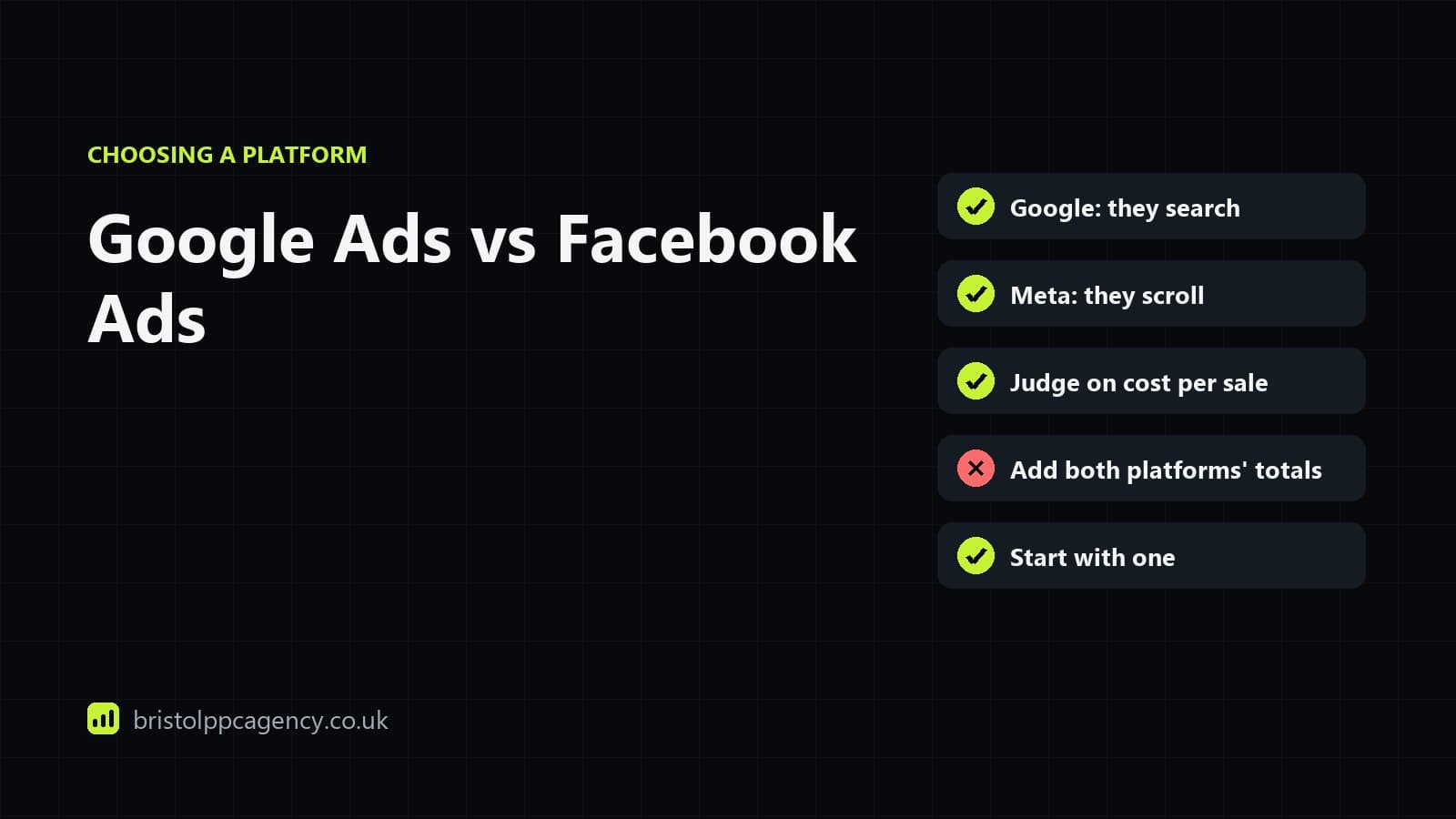
Google Ads reaches people who are already searching for what you sell; Facebook and Instagram ads reach people who are not searching but match the kind of customer you want. Google is usually better for urgent and considered purchases where people search first, and Facebook for visual products, impulse buys and creating demand that does not exist yet. The right choice depends on whether your customers look for you or need to be shown you.
The core difference: intent versus discovery
On Google, the searcher has told you what they want. Your job is to be the best answer, so the keyword and the landing page do most of the work. On Facebook and Instagram nobody asked; the ad has to stop someone scrolling and make them want something. That makes the creative, the image or video and the first line, the most important part of a Meta campaign.
| Google Ads | Facebook and Instagram | |
|---|---|---|
| Reaches | People searching now | People who match an audience |
| Main lever | Keywords, bids and landing page | Creative and offer |
| Best for | Urgent needs, services, high-intent products | Visual products, impulse buys, events, awareness |
| Cost per click | Often higher, especially for services | Often lower, but each click is less ready to buy |
| Targeting | By search, location, device, audience | By interests, behaviours, demographics, lookalikes |
| Speed to results | Fast where search demand exists | Fast to test creative; slower to build demand |
Choose Google first if
- People search for your service or product by name.
- The need is urgent: repairs, emergencies, last-minute bookings.
- The purchase is considered and researched, such as professional services or B2B.
- You have little creative material such as photos or video.
Choose Facebook and Instagram first if
- Your product is visual and easy to show in a few seconds.
- Few people search for it because they do not know it exists.
- You can describe your customers by interests, life stage or behaviour.
- You are promoting an event, a launch or a time-limited offer.
Using both
Many businesses grow fastest using both, each for its own job. Google captures demand; Meta creates it and brings back people who visited without buying. A common pattern is Meta introducing a product, people later searching for the brand on Google, and a search ad catching them. That is also why the two platforms often both claim credit for the same sale, and why we report them side by side rather than adding their figures together.
Measuring them fairly
Google and Meta count conversions differently, with different attribution windows, and each tends to credit itself. Compare them on a common measure, such as cost per lead or cost per sale from your own records or GA4, rather than on each platform's own report. Proper tracking on both, including Meta's Conversions API, makes the comparison possible.
Comparing costs fairly
A cheaper click is not a cheaper customer. Someone who searched for your service on Google is usually further along than someone who tapped a Facebook ad while scrolling, so the Facebook click converts less often. Compare platforms on cost per lead or cost per sale over the same period, measured in your own system.
What each needs from you
| Google Ads | Facebook and Instagram | |
|---|---|---|
| Most important input | Keywords and a matching landing page | Images or short video that stop the scroll |
| Ongoing work | Search term reviews and negatives | A steady supply of new creative |
| Tracking | Google Ads conversions and GA4 | Meta pixel and Conversions API |
Two example splits
These are illustrations, not recommendations for every business. A local electrician might put nearly all of a small budget into Google search and Local Services Ads, with a little Facebook remarketing. An online clothing shop might split more evenly: Google Shopping for people searching for products, and Instagram for showing new ranges to people who have never heard of the shop.
When to add the second platform
Add the second platform once the first is profitable and stable, not while it is still learning. A useful sign is that the first platform's cost per lead has held steady for a month or two and extra budget there is producing fewer extra results. That is the point where a new platform's audience is worth more than more of the same.
Written by
Web developer and paid search specialist at Webso Digital, which runs Bristol PPC Agency. Builds the campaigns, the landing pages and the tracking, and writes these guides from that work.
Questions on this topic
Are Facebook ads cheaper than Google Ads?
Facebook clicks are often cheaper, but the people clicking are usually less ready to buy than someone who searched. Compare cost per lead or cost per sale, not cost per click.
Which is better for a local business?
For services people search for, such as trades or clinics, Google usually works first. For local consumer offers, events and visual businesses, Facebook and Instagram can work well.
Can I run both with a small budget?
It is usually better to start with one, get it working, and add the other. Splitting a small budget leaves neither with enough data to learn.
Why do Google and Facebook both claim the same sale?
Each platform counts a sale it contributed to within its attribution window, so a customer who saw a Facebook ad and later clicked a Google ad is counted by both. Use your own records to see the real total.
How do I know which platform is working?
Measure both against the same records: enquiries or sales logged in GA4 or your own system, over the same period. Each platform's own report credits itself generously, so the honest comparison is cost per lead or cost per sale from your side.